

Too many nonprofits refuse to confront the uncomfortable. They cling to a “business as usual” approach until they are already choking on the smoke filling the room. The smoke they see usually looks like a precipitous decline in revenue. By the time they notice it, they are combating a lagging indicator rather than the root cause.
Organizations often revert to traditional playbooks or make drastic cuts to operations. They hunt for new donors or squeeze existing supporters for bigger donations. In their panic, they try to clear the visible smoke and completely miss the smoldering fire burning right beneath their feet.
Firefighting is a reactive task, whereas innovating for the future is proactive.
To break the stagnation facing many nonprofit organizations, leaders must anchor themselves to the organization’s purpose and align the new solution with current and future needs in the marketplace or social landscape.

Anchor to Purpose
Over the years, Crescere Strategies LLC professionals have worked with nonprofit organizations and school systems to maximize their impact on society in the United States and internationally. The Firm helps nonprofits renew their operations and increase their sustainability. The starting point is conducting a structured diagnostic process called the Rapid Structured Study.
First, organizations must ruthlessly re-anchor themselves to their true purpose. In classical mechanics, one cannot calculate the trajectory of a moving body without first establishing a fixed point of origin. In organizational architecture, that fixed point—or teleology—is the ultimate purpose for which an institution was engineered.
Lasting nonprofits are originally chartered as targeted interventions designed to eliminate a specific market failure, systemic friction point, or societal imbalance. This foundational purpose is the system’s baseline vector. For example, one nonprofit’s stated purpose is to ensure that all children (especially children with gifts and talents) “have opportunities and support to realize their full potential.” It aims to accomplish this purpose by arming the caregivers of these children with the tools to support them through advocacy, outreach, education, and research.
Unfortunately, as institutions scale, they naturally succumb to systemic entropy. Over successive budget cycles, an organization’s internal mechanics almost always decouple from its core thesis. The entity undergoes a radical mutation: it transitions from a mission-delivery vehicle into a self-preserving bureaucracy.
When capital grows scarce and “smoke fills the room,” organizations often default to protecting the bureaucracy’s current operations rather than adapting to current needs.
Organizations attempt to solve an external alignment problem with internal operational efficiency. To break this defensive insulation, a first-principles diagnostic must invert the inquiry, forcing leadership to answer two existential questions:
What is the fundamental problem the founders were trying to solve? This requires stripping away legacy programs, accumulated institutional habits, and emotional attachments to specific activities to isolate the raw, unvarnished hypothesis upon which the organization was built.
Is this the same problem that we still face today? Ecosystems mutate. Societal needs evolve, digitize, and decentralize. If an organization blindly chases historical revenue targets without verifying that its core problem still exists in its original form, it risks engineering a highly optimized machine designed to solve a problem the world has already moved past.
An organization does not possess an inherent right to exist at a specific revenue level, nor does it have a mandate to protect its historical scale. Capital is allocated by the marketplace purely to achieve agreed-upon goals and solve a problem. Organizations that deviate from their true purpose and try to optimize their operations may inadvertently realign themselves for decline.
The Rapid Structured Study
Once an organization is securely re-anchored to its true purpose, leadership must transition from philosophical verification to clinical diagnostic execution. The most effective and sustainable nonprofit organizations engage in a “Rapid Structured Study”—a high-intensity evaluation engineered to ruthlessly audit the institution across three interdependent structural pillars.
1. Bounded Temporal Velocity (30 Days or Less)
Traditional consulting models favor longitudinal, multi-month planning horizons. In a volatile ecosystem, this latency is fatal. Prolonging the diagnostic window introduces an institutional decay function known as “change fatigue.” Human systems possess finite psychological bandwidth for ambiguity and trying new things. When an executive team spends months studying the environment without executing a counter-strategy, organizational anxiety spikes, operational momentum collapses, and the system suffocates.
A Rapid Structured Study must be executed in 30 days or less. It behaves like triage, bypassing consensus-driven committees in favor of cross-sectional, high-integrity data streams reviewed through the lenses of professional behavioral science and organizational anthropology.
2. Strategic Frequency
The operational frequency of a Rapid Structured Study is neither static nor dictated by arbitrary calendar cycles. How often an organization deploys this diagnostic depends entirely on how rapidly its specific market changes and the degree of existential pressure it is under to adapt.
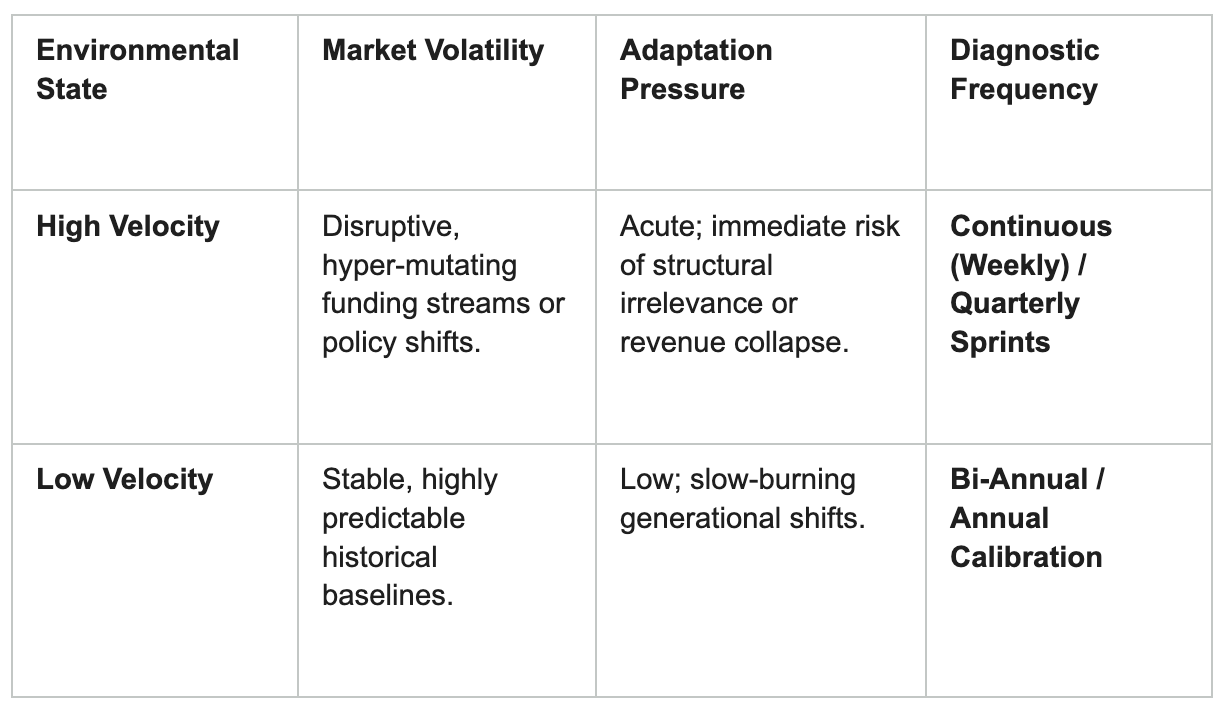
Bi-Annual / Annual Calibration
An organization cannot rely on a traditional strategic plan drawn up every three to five years. The external ecosystem mutates at a much faster metabolic rate than internal bureaucracies. By matching the frequency of the Rapid Structured Study to the landscape’s velocity of change,.the environment, leadership transforms the study from a reactive crisis operation into a proactive steering mechanism.
3. Habitual Integration
Ultimately, the Rapid Structured Study must become institutional muscle memory. Organizations fail because they default to the bad habit of blindly executing legacy programs under stress. The systemic countermeasure is to replace that reflex with virtue—an ingrained, cultural rhythm of structural assessment. When the Rapid Structured Study becomes habitual, leadership no longer waits for the room to fill with smoke blinding their vision; they constantly monitor the system’s ambient heat.
With these parameters locked, the study systematically audits the organization across its three vital axes:
Pillar I: Functional Output
The first pillar of the Rapid Structured Study requires separating why the organization exists from what it actually produces.
Under existential stress, human systems do not naturally seek innovation; they seek comfort, routines, and habits. For an established nonprofit, comfort lies in its operational legacy—the specific programs, fundraising formats, and service-delivery models it has spent years perfecting. This introduces a profound logical error: mistaking the tool for the objective.
A nonprofit’s programmatic portfolio is not its purpose. Programs are merely provisional, temporary mechanisms chosen at a specific point in time to achieve a desired outcome.
When the external environment shifts, the functional utility of those historical tools frequently drops to zero. Trapped by operational inertia, leadership teams routinely attempt to solve an external alignment problem by increasing internal execution velocity. They run the obsolete playbook harder. They squeeze donors tighter, optimize underperforming programs, and cut critical overhead, falsely believing that efficiency can compensate for structural irrelevance.
A rigorous audit of Functional Output demands that change leaders subject every tactical asset to a cold, empirical assessment. The question is no longer, “How do we fund this program?” The question must be: “Does this specific output still possess the functional capacity to achieve our core purpose?” If the mechanism no longer serves the objective, it must be decommissioned, regardless of its institutional heritage.
Pillar II: Environmental Discovery
Evaluating whether an organization’s tools possess functional capacity requires it to shift its gaze from internal mechanics to external, empirical realities. This is the pillar of Environmental Discovery.
Environmental Discovery does not evaluate the market blindly. It maps the organization’s foundational Anchor to Purpose directly against the external market’s current needs, utilizing a dual-engine approach of hard data and radical empathy. The clinical question at the center of this pillar is: What is the exact problem to be solved today, and what is our reasonable level of investment to achieve impact?
1. The Tool of Radical Empathy: Piercing the Validation Trap
To discover true contemporary needs, the diagnostic team must deploy radical empathy as a rigorous instrument for data gathering. Radical empathy is the deliberate practice of dismantling institutional assumptions to see the ecosystem purely through the eyes of those served.
Without this discipline, organizations fall into the validation trap—issuing leading surveys designed to confirm that their existing programs are still liked. True discovery requires objective, qualitative research instruments executed within the 30-day window:
Structured Deep-Dive Interviews: Engaging directly with constituents to map their daily friction points, ignoring whether those friction points align with the nonprofit’s current services.
Targeted Modern Surveys: Quantifying the prevalence of new problem mutations across the broader landscape.
Practical Experiential Exercises: Forcing the leadership team to walk through the modern constituent’s actual journey to locate hidden bottlenecks, information asymmetries, and systemic gaps.
2. The Scale Matrix: Mutation of the Problem & Capital Thresholds
Once radical empathy reveals the raw modern landscape, leadership faces a critical, bifurcated choice regarding the problem’s mutation. This is perfectly illustrated by the evolution of legacy institutions:
Case in Point: The Evolution of Care and Cure
Consider a healthcare organization founded more than 50 years ago. Its original, foundational hypothesis was rooted in isolation: the founder suffered from a rare disease and built the institution to provide a mechanism for patients to connect and find camaraderie.
Five decades later, deep empirical discovery reveals that the problem has completely mutated on two distinct fronts:
The Care Pivot (Information Asymmetry): Due to digital decentralization, modern clients need less basic camaraderie and far more objective, high-velocity information regarding effective medications, clinical trials, and emerging products on the market.
The Cure Pivot (Resource Thresholding): Over the past 50 years, the organization has accumulated significant financial resources, donor networks, and institutional capital. Leaders must evaluate the critical resource threshold: Does our financial asset base reach a scale that will make a demonstrable impact?
If an organization’s investment capability can breach the necessary financial threshold to catalyze root-cause eradication, continuing to exhaust 100% of its capital on legacy support groups is an optimization failure. Conversely, if it sits below that threshold, it must optimize its utility by providing the precise medication and product intelligence the market currently lacks.
Pillar III: Operational Function
The final pillar of the Rapid Structured Study turns completely inward to audit the organization’s
System Architecture.
When an external landscape shifts, an organization’s failure to adapt is rarely due to a deficit of hours worked or sheer effort. Instead, the bottleneck lies within the structural configuration of its human capital. Under existential stress, human systems suffer from regression, avoidance, or dysfunction—a systemic vulnerability in which teams may instinctively retreat to historical habits and legacy processes because they are familiar, even if they are no longer useful.
To break this paralysis and restore functional plasticity—the systemic capability to rapidly reorganize internal components in response to external mutations—the System Architecture audit must bypass superficial job titles. Within the 30-day window, leadership must execute a cold, clinical evaluation of the team across two distinct operational axes:
1. Job Function Analysis: Role-to-Need Mapping
This axis is a cold, empirical audit of what your personnel actually do. Leadership should collect existing job descriptions and cross-reference them directly against the modern friction points discovered during the Environmental Discovery phase. The diagnostic objective is to answer a singular question: How well do our current staff functions align with the market’s current and future needs?
The Legacy Deficit: In a stagnating system, job descriptions are almost always built around maintaining legacy infrastructure (e.g., organizing support galas, managing legacy databases, or running historical support groups).
The Future Pivot: If the market now demands high-velocity product information, complex clinical trial navigation, or macro-scale research fundraising, leadership must map out the gap between current activities and future requirements.
If your staff’s daily output is structurally hardwired to solve yesterday’s problems, the organization is paying for a machine that produces irrelevance. Job functions must be ruthlessly rewritten to match the modern vector of impact.
2. The Traits Audit: Psychometric Calibration
Rewriting a job description is meaningless if the individual occupying the role lacks the intrinsic capacity to execute it. The second axis requires a psychological and behavioral audit of the team. Leaders must look past technical skills and evaluate the staff’s underlying cognitive and emotional architecture, split cleanly between two dimensions:
Stable Personality Characteristics: These are the deeply ingrained, relatively fixed behavioral baselines of your personnel (e.g., core cognitive processing style, natural baseline of openness to experience, and intrinsic risk tolerance). Leadership must determine whether an individual team member’s fixed characteristics align with the operational demands of the new strategy. A high-stakes pivot into funding global scientific research and discovery, for instance, requires a stable personality baseline optimized for macro-analytical thinking and strategic risk-taking, rather than low-variability administrative execution.
Adaptive Affective Traits: These are an individual’s dynamic emotional states, mindsets, and capacities for responsiveness under duress. This measures the system’s affective agility—how well individuals manage ambiguity, process change, and display resilience when their legacy playbooks are dissolved. A team choked by fear and clinging to old memories lacks the adaptive affective traits required to embrace a high-velocity pivot.
Measuring individual stable personality characteristics and adaptive affective traits is a powerful method for optimizing the implementation of initiatives and plans.
The Diagnostic Horizon: From Study to Understanding
A Rapid Structured Study, anchored relentlessly to an organization’s founding purpose, is not an academic exercise; it is a clinical survival mechanism. By auditing Functional Output, mapping the market through Environmental Discovery, and dissecting System Architecture via Operational Function, leadership teams stop fighting the smoke and begin targeting the fire.
However, raw data collection without a structured framework for progression merely creates organized panic, analysis paralysis, and noise.
Within the proprietary Pathway to Achievement—a business architecture designed by M. René Islas to synchronize organizational strategy with Bernard Lonergan’s Generalized Empirical Method (GEM)—this Rapid Structured Study represents Phase 01: Study. It is the rigorous intake of baseline experience and systemic data.
The Understand phase transitions from external environmental data to the internal quantification of human assets and comprehensive data. When an organization grapples with this data, the System Architecture comes alive.
Initiate Your Diagnostic
To explore the complete architecture of the Pathway to Achievement and learn how organizations move systematically from the initial Study phase into sustained strategic momentum, visit www.crescere-strat.com.
If you are ready to begin the Understand phase and audit your team’s psychological baseline, you can access our provisionally patented, proprietary intelligence engines to assess your team’s characteristics and traits—specifically the OCEAN Behavioral Profile and the PANAS-X Affect Audit—entirely for free at the Crescere Strategies Intelligence Toolkit.
Don’t be blinded by the rising smoke; conduct a Rapid Structured Study and stop running legacy playbooks that waste the organization’s time and drain resources.Crescere Strategies LLC